Thursday, October 4, 2018


I wish they'd stop and talk about it. They don't though. They just march by pointing at the sign, hardly looking at me, and saying, 'Aaah, I think you need a question mark.'  They don't, but they all could have Red Sox caps on. Luckily it doesn't happen often

If they thought about it, they'd realize there'd be a difference in the tone and meaning of the sign's message if I'd put in a question mark. I'd say to them, if they stopped, that a question mark is too soft a landing.


Wednesday, October 3, 2018


The Times was sold-out in the bodega where I get it in the morning. I had to go across the street and look for one. This is the Times editorial on the massive story it ran today:


Donald Trump and the Self-Made Sham

Now let’s see your tax returns, Mr. President.


“I built what I built myself.”

This boast has long been at the core of the mythology of Donald Trump, Self-Made Billionaire. As the oft-told story goes, young Mr. Trump accepted a modest $1 million loan from his father, Fred, a moderately successful real estate developer from Queens, and — through smarts, hard work and sheer force of will — parlayed that loan into a multibillion-dollar global empire.

It’s a classic American tale of ambition and self-determination. Not Horatio Alger, exactly, but appealing, and impressive, nonetheless.

Except that, like so much of what Mr. Trump has been selling the American public in recent years, this origin story was a sham — a version of reality so elaborately embellished that it qualifies as fan fiction more than biography. Also, as we’ve come to expect from Mr. Trump, the creation of this myth involved a big dose of ethically sketchy, possibly even illegal activity.

As an in-depth investigation by The Times has revealed, Mr. Trump is only self-made if you don’t count the massive financial rewards he received from his father’s business beginning as a toddler. (By age 3, little Donald was reportedly pulling in an annual income of what today would be $200,000 a year.) These benefits included not only the usual perks of hailing from a rich, well-connected family — the connections, the access to credit, the built-in safety net. For the Trumps, it also involved direct cash gifts and tens of millions in “loans” that never charged interest or had to be repaid. Fred Trump even purchased several properties and business ventures, putting ownership either fully or partly in the names of his children, who reaped the profits.


As Donald Trump emerged as the favorite son, Fred made special deals and arrangements to increase Donald’s fortunes in particular. The Times found that, before Donald had turned 30, he had received close to $9 million from his father. Over the longer haul, he received upward of what, in today’s dollars, would be $413 million.

Along the way, it seems that certain liberties were taken with tax laws. The Times found that concocting elaborate schemes to avoid paying taxes on their father’s estate, including greatly understating the value of the family business, became an important pastime for Fred’s children, with Donald taking an active role in the effort. According to tax experts, the activities in question show a pattern of deception, a deliberate muddying of the financial waters. Asked for comment on The Times’s findings, a lawyer for the president provided a written statement denying any wrongdoing and asserting that, in fact, Mr. Trump had little to do with the dizzying transactions involving his family’s wealth.

Everyone can understand the impulse to polish one’s background in order to make a good impression. For Mr. Trump, whose entire life has been about branding and selling a certain type of gaudy glamour, this image-polishing has been all the more vital to his success. And he has pursued it with a shameless, at times giddy, abandon.

Veterans of New York news media still laugh to recall how Mr. Trump would call them up, pretending to be a publicist named John Barron, or sometimes John Miller, in order to regale them with tales of Mr. Trump’s glamorous personal life — how many models he was dating, which actresses were pursuing him, which celebrities he was hanging out with. As gross and tacky and bizarre as this all seemed, it was aimed squarely at fostering the image of Donald Trump as a master of the universe who, as the cliché goes, women wanted and men wanted to be.


With this glimpse into the inner workings of the Trump family finances, some of the grimier, ethically suspect aspects of Mr. Trump’s mythmaking begin to emerge — and with them, many questions about all that we still do not know about the man and his business empire. Seeing as how that empire and his role in building it are so central to who Mr. Trump claims to be — the defining feature of his heroic narrative — the American public has a right to some answers. For starters, now would be an excellent time for Mr. Trump to hand over those tax returns on which he has thus far kept a death grip.

In his 1987 memoir “The Art of the Deal,” Mr. Trump famously offered his take on the origins of his success: “I play to people’s fantasies. People may not always think big themselves, but they can still get very excited by those who do. That’s why a little hyperbole never hurts. People want to believe that something is the biggest and the greatest and the most spectacular. I call it truthful hyperbole. It’s an innocent form of exaggeration — and a very effective form of promotion.”

But increasingly, Mr. Trump’s willingness to bend the truth — and the rules — in the service of his myth looks less like innocent exaggeration than malicious deception, with a dollop of corruption tossed in for good measure. It’s not the golden, glittering success story he has been peddling. It’s shaping up to be something far darker. 


Monday, October 1, 2018

from today's Times:

From Orwell to ‘Little Mermaid,’ Kuwait Steps Up Book Banning

Books were hung from a palm tree in Kuwait City on Saturday to protest official censorship.(CreditCreditYasser Al-Zayyat/Agence France-Presse — Getty Images)
  • KUWAIT — No book, it seems, is too substantive or too insignificant to be banned in Kuwait. Recent targets of the government’s literary censors include an encyclopedia with a picture of Michelangelo’s David and a Disney version of “The Little Mermaid.”
David had no fig leaf, and the mermaid, alas, wore half a bikini.
“There are no hijab-wearing mermaids,” said Shamayel al-Sharikh, a Kuwaiti women’s activist. “The powers that be thought her dress was promiscuous. It’s humiliating.”
Social conservatives in Kuwait objected to her bikini top.CreditCreditTrailer for The Little Mermaid: Ariel's Beginning
Kuwaitis like to think of their country as an enclave of intellectual freedom in the conservative Persian Gulf, a haven that once welcomed exiled Arab writers. But that self-image is becoming harder to sustain.

Responding to the demands of a growing conservative bloc in Parliament, the government is increasingly banning books.
In August, the government acknowledged that it had banned 4,390 books since 2014, hundreds of them this year, including many works of literature that had once been considered untouchable, setting off street demonstrations and online protests.

Sometimes the 12-member censors committee (six Arabic readers, six English readers) that rules on books for the Ministry of Information gives a reason: The anthology “Why We Write” was banned because its editor, Meredith Maran, had falsely accused her father of molestation.

In other cases, the justification is obscure, such as with “The Art of Reading,” by Damon Young. Maya Angelou is honored with a postage stamp in America, but her memoir, “I Know Why the Caged Bird Sings,” is forbidden in Kuwait.
Prize winners are not immune — in fact they seem to be frequent victims. “One Hundred Years of Solitude,” by the Nobel Prize winner Gabriel García Márquez, is banned because of a scene in which a wife sees her husband naked, as is “Children of Gebelawi,” by the Egyptian author Naguib Mahfouz, the first Arabic-language writer to win the Nobel in literature.

If all that seems rather Orwellian, George Orwell’s “1984” is also banned, in at least one Arabic translation, though it is allowed in another.

Kuwaiti readers have struck back with a mix of brio and scornful mirth. Some posted photographs on Twitter and Facebook of piles of banned books they have in their home libraries.
At Saturday’s protest against censorship. In the past 11 months, 700 books have been banned. (Credit Yasser Al-Zayyat/Agence France-Presse — Getty Images)
Authors suggested that online delivery services from abroad could evade the ban, which applies mostly to bookstores and local publishers. “Now books are becoming like drugs,” said Hind Francis, an activist with a Kuwait anti-censorship group called Meem3. “You have to have your banned-book dealer.”

Activists and writers gathered to protest the book ban three times in September, most recently on Saturday, the last day of the international Banned Books Week. Kuwait is one of the few Gulf countries that allow public protests, although they are strictly controlled. The protests have been lightly attended, but any outdoor crowd has to brave temperatures that still reach 100 degrees.

“It’s a challenge, but we tell them we’ll keep it to only an hour,” said Fatima Matar, a law professor and a founder of the protest effort.

With the country’s book fair — the third largest in the Arab world, after Cairo and Beirut — scheduled in November, officials have pushed back. “There is no book banning in Kuwait,” read a recent statement by the Ministry of Information. “There is a book censorship committee that reviews all books.”

An assistant minister of information, Muhammad Abdul Mohsen al-Awash, elaborated. “In Kuwait, over the past five years only 4,300 books were banned out of 208,000 books — that means only 2 percent are banned and 98 percent are approved,” he said. “Some books are being banned in the U.S., Europe, Beirut and other countries, too.”

In the past 11 months, he said, 3,600 books were approved by censors, while 700 were banned.

Yet, he insisted, “since its inception, Kuwait has always been known for its sponsorship of literature and culture.”
It is a particularly sensitive issue because Kuwait’s emir, Sheikh Sabah al-Ahmad al-Sabah, has pushed to make his country a regional cultural hub. While theater, dance and music are under royal patronage and exempt from censorship, books are not.

“That cultural hub just cannot happen when you have a book massacre like this, all these books being banned,” said Bothyana Al-Essa, a Kuwaiti author whose book “Maps of Wandering” was banned. Kuwaiti censors banned the book over a child abuse scene set in Mecca, Saudi Arabia, she said, but the Saudis never banned the book in their country, where it was a best seller.

Bans have for the first time extended to many international books and reference books already on Kuwaiti shelves, at least in part because of parliamentary pressure, critics say.

“This year they’ve gone into the ridiculous,” said Ms. Sharikh. “Children’s stories and books by Kuwaiti authors.” Even works produced by the government’s own publishing house in the Public Council for Culture, Arts and Literature have been banned, such as a scientific study of hymens, according to Ms. Francis.

Kuwait’s history of literary freedom is, activists say, the reason book banning is so distressing to the intelligentsia. “Kuwait has had a significant amount of progress when it comes to civil liberties,” Ms. Sharikh said. “We are the trendsetters in the Gulf region and have been for many decades.”

Many banned books are still on sale in bookstores, but some sellers have removed offending titles.CreditYasser Al-Zayyat/Agence France-Presse — Getty Images
The Kuwaiti Parliament is the most independent in the Gulf, but that has also become the problem, bibliophiles complain. In effect, “democracy has become the enemy of democracy,” Ms. Matar said. “They believe we should all think alike.”

Because Kuwait’s parliament has the authority to call a vote of confidence on individual ministers, and has forced resignations, the ministers tread carefully, especially on explosive social issues.

Authors and their supporters say the Ministry of Information has responded to parliamentary pressure by giving the censors sweeping powers to ban books, even though the Kuwaiti Constitution guarantees intellectual freedom.

Arwa Alwagayan, a Kuwaiti author, said her book “Be Well” was banned because of a passage that said the Islamic State was attracting teenagers “in the mosques.” The censors demanded she change that to “in some mosques,” and she refused.

For some local authors, having their books banned has created a sales opportunity. After Mohamed Ghazi’s book “Blue” was banned over a passage on Page 56, Mr. Ghazi, an Iraqi who writes in English and lives in Kuwait, used Twitter to invite readers to buy it to find out why. His sales more than doubled, he said.

Such defiance is rife. Many banned books are still on sale in bookstores in Kuwait; recently, at the country’s largest, the Jarir Bookstore in Shamiya, there were books on display by Márquez and Orwell, along with one not-very-risqué copy of Hans Christian Anderson’s bikini-clad mermaid.
But other outlets, mindful of heavy fines, are removing offending titles.

“It’s happening gradually, but slowly and surely books are disappearing,” Ms. Matar said. New books by Kuwaiti authors are especially vulnerable, because if banned they cannot be printed and distributed. Ms. Matar’s book of poetry was banned from sale when she refused to delete an offending line, she said.

“We don’t want to get to that stage where we go to our bookshops and only find cookbooks and books about Shariah law,” she said.

Underground banned-book dealers are already doing a brisk business serving literary scofflaws. Many use Instagram’s disappearing photo feature to display their wares, take orders and stay a step ahead of the law, according to one young author who said he supplements his income that way.

At a bookstore in Kuwait City, the proprietor showed off a secret cupboard full of contraband books behind the cash register and a basement storeroom with even more. “It’s a cliché that book banning helps book sales,” she said. “As a bookseller, I can tell you I would much rather have the books out on display.”

The bookseller did have a banned copy of “Zorba the Greek” on display, discretely, since it could result in a minimum fine of about $1,650 if Ministry of Information inspectors saw it. She said she was not too worried. “You can always spot them when they come in,” she said. “You can tell they’re not readers.”

Follow Rod Nordland on Twitter: @rodnordland.
Hwaida Saad contributed reporting from Beirut.


Saturday, September 29, 2018


from the Washington Post:

It is very difficult to get the train to stop


By Alexandra Petri
Columnist
September 28 at 4:09 PM


“I was … wondering whether I would just be jumping in front of a train that was headed to where it was headed anyway, and that I would just be personally annihilated.”
 Christine Blasey Ford, on whether to come forward


I am so tired.


The train is very, very urgent. It is moving a man’s career forward. 

It is very difficult to get the train to stop.


The presumption is that the train will not stop. The presumption is that you will be a scream thrown on the tracks. That it will require a great many of you to be thrown onto the tracks before the train will grind to a halt. It can never be just the one; it must be several at once. Someday we will know the precise conversion. We will tell them: Do not bother unless there are 20 others like you, because the train will continue, and you will be crushed.


It is painful to watch a woman caught and torn in the gears of a man’s progress. To watch the meaning of her name change into a thing that happened to her once. To watch the first sentence of her obituary get rewritten. To watch her name be linked to this man’s name (Anita, accuser of Clarence; Christine, accuser of Brett). All she asks is for the train to stop.


To make the train stop, you must throw yourself in front. Your whole self. Your fear of flying. Your family.


You must throw yourself in front of the train, but still it may not be enough. These trains move very fast. We must not ask why.


Maybe the train will stop for a week. That seems fair. A week, just to make sure. A week, to take this seriously, at a gentleman’s request.


But I am so tired.


I am so tired of this constant parade of pain.


In the Bible, Thomas says he will not believe what Jesus has survived unless he can stick his hand into the wounds. But this is not a reasonable thing to ask of someone who is not God, to stick your hand into their wound. I am tired of watching people become wounds. Half the Internet is a wound. Have you stuck your hand in it enough? Do you believe yet? The #MeToo movement lurches forward over a path of scars. The change is so slow and the sacrifice it demands so great.

Even as she testified Thursday, Christine Blasey Ford kept apologizing. (“I’m sorry,” she said. “I can read fast!” she said. She was here to be “helpful,” she said.)


Someday I want to not be tired.


Someday I want us not to apologize.


Women are used to squinting to see our own stories in the stories of others. To reading ourselves into the words “all men are created equal.” To being the thing tied to the tracks to raise the stakes.


I am so tired of the moment when you discover how little your weight counts against the train’s.

I want us to be the train and not the thing thrown under it.


I want us to be the thing too urgent to be stopped, not the thing that must curl up apologetically to make room for it.


Is it too much to ask to be the train sometimes? Not all the time, just sometimes.


I am so tired of watching us jump.


I am so tired of watching the trains keep going.


Friday, September 28, 2018

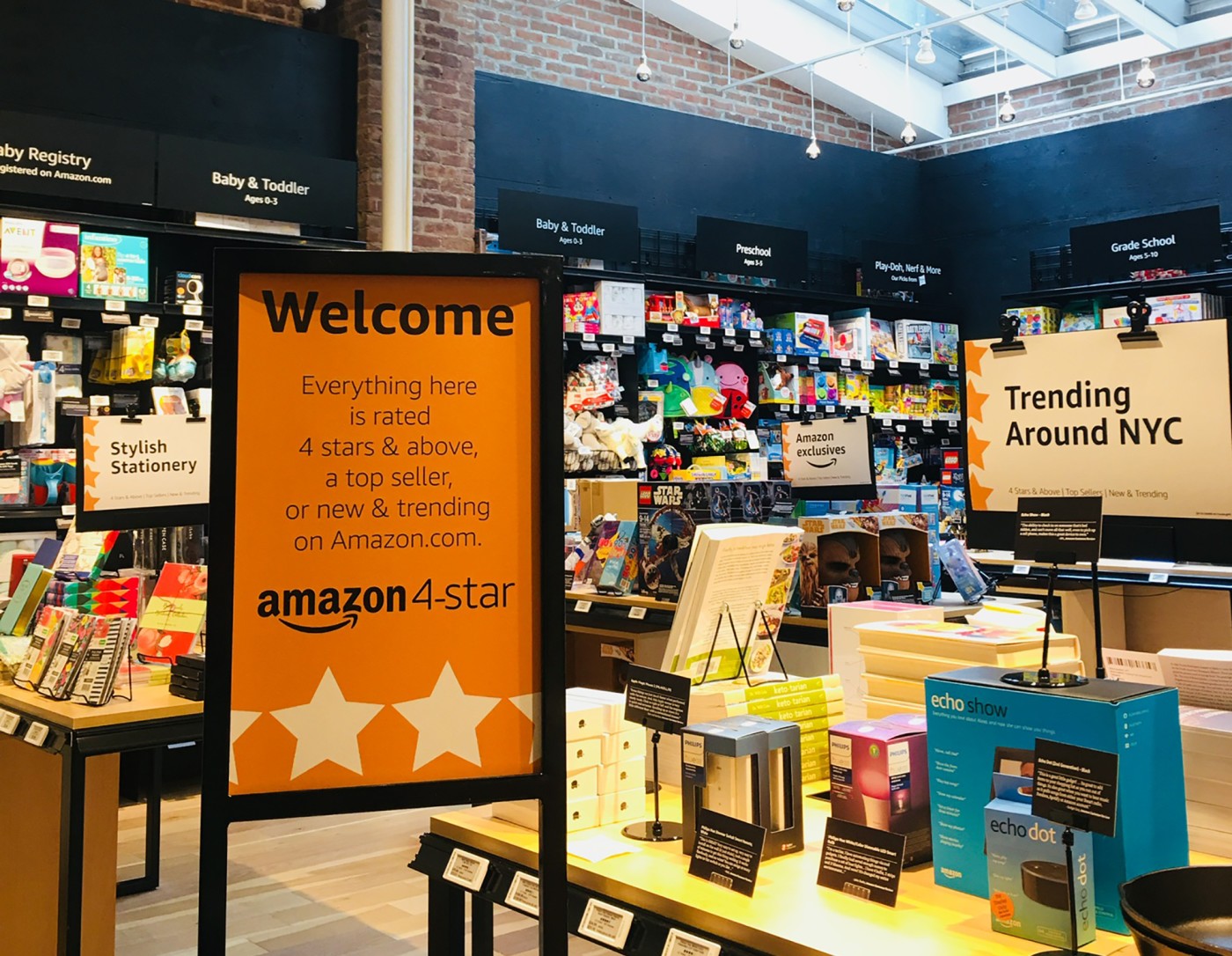
The Amazon store will be on the street where the perfection-of-a-bookstore McNally-Jackson is.


This I read on 'Lit Hub' today:

'Amazon 4-star' Concept Store Opens in NYC

Amazon 4-star, a new physical store "where everything for sale is rated 4 stars and above, is a top seller, or is new and trending on Amazon.com," opens today in New York City, at 72 Spring Street in SoHo. According to the company, Amazon 4-star was created "to be a place where customers can discover products they will love. Amazon 4-star's selection is a direct reflection of our customers--what they're buying and what they're loving."
The store is stocked with products from some of the most popular categories on Amazon.com, including devices, consumer electronics, kitchen, home, toys, books and games. Prime members pay the Amazon.com price in the store, which features sections like "Most Wished For" items, "Amazon Exclusives" and "Frequently Bought Together," as well as "Trending Around NYC."
"Amazon apparently isn't done testing out new store concepts," CNET wrote, adding: "With so many store concepts, it seems clear Amazon is still experimenting and hasn't yet landed on a single top store idea it could expand to many more cities."


Thursday, September 27, 2018


A fearless-looking, lean African American guy in his 30s comes by my sign quite often and yesterday he stopped and asked me what my hours were. I said, 'I'm here every day 8:00-9:00. I've been away for a week to see my youngest daughter and my grandchildren.' He said, 'I wondered how many kids you had.' I said, 'Three daughters.' 'Interesting,' he said, 'I think Malcolm had four daughters.'