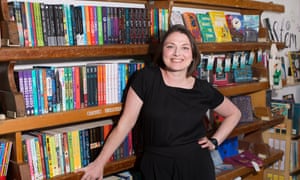
City Council Speaker Corey Johnson reads to toddlers outside
City Hall on May 29, 2019. (Jonathan Blanc/New York Public Library)
NEW YORK — The steps of City Hall hosted an unusual protest
late last month when City Council Speaker Corey Johnson read to a crowd
of toddlers wearing orange T-shirts. The book they heard, "Too Many Carrots," tells the story of a rabbit whose abundance of the vegetables threatens to push him out of his burrow.
New
York City's public library systems face the opposite problem: The
upcoming municipal budget could leave them with a lack of cash that may
result in cuts to programs like the story time Johnson held.
Mayor Bill de Blasio's executive budget
for the 2020 fiscal year includes about $387.1 million for the New York
Public Library, the Queens Public Library, the Brooklyn Public Library
and city research libraries. That's about $11.7 million less than the
library funding that ended up in the current year's budget, records show.
The reduction would deliver a blow to
libraries following an expansion of their services and physical
footprints in recent years, forcing them to cut hours and programs that
patrons depend on, library officials say.
"Our communities have
come to rely on what we're doing today. We'd like to continue at that
level," Linda E. Johnson, the Brooklyn Public Library's president and
CEO, said at a rally last month. "We're getting stretched thinner and thinner with each passing year where the budget stays the same."
Bolstering
library funding is a top priority for the City Council as it negotiates
the budget with the de Blasio administration. The Democratic mayor and
the council must agree on a budget before the new fiscal year begins
July 1.
Lawmakers have joined the libraries in calling for City
Hall to add $27 million in library funding and baseline another $8
million that the council threw into the current budget. Continuing to
support libraries should also be a priority for de Blasio, who is campaigning for president as a progressive leader, council members argue.
"Libraries
are one of the most egalitarian things, not just about New York City
but about society," Johnson, a Democrat, said June 6. "And libraries are
a gateway to new immigrants, libraries are laboratories for learning,
libraries are places for children and for seniors. They're free, and
it's really about greater personal education and evolution."
City
funding accounts for the majority of the budgets of all three major
library systems. All of them have built new and larger facilities, with
the de Blasio administration's approval, that require extra books and
staff, said Iris Weinshall, the New York Public Library's chief
operating officer.
The libraries also offer many services
including some that de Blasio has championed, such as immigration
counseling and work with the city's Thrive NYC mental health initiative,
according to Weinshall.
The cuts could particularly affect
libraries' weekend service. Seven of the New York Public Library's 88
branches in Manhattan, The Bronx and Staten Island are currently open on
Sundays, but that number would likely drop to zero if the budget forced
cuts, Weinshall said. The library may also have to reduce Saturday
hours, she added.
Those reductions could affect kids — libraries
saw more than 1.1 million visits to story times and other free early
literacy programs in the 2018 fiscal year, about 10 percent of which
came on weekends, the NYPL says.
"You
can just get so much blood from a stone," Weinshall said. "You just
have so much staff and so many hours in the day, and if we don't have
the staff to be able to cover these branches, we will have to cut back
on hours."
Weinshall and Johnson conceded that de Blasio has been
good to the libraries during his tenure. His administration has
increased city funding for libraries by nearly 30 percent and made a
significant investment in their infrastructure, according to City Hall.
"We've
made a record level of investments in the City's libraries," de Blasio
spokesman Raul Contreras said in a statement. "This includes funding for
six-day service in every borough, and investing more than $1 billion
over the next ten years for facility improvements across the three
systems. We're in regular contact with the libraries about their needs,
and look forward to continuing our conversation with the City Council."
But that hasn't stopped library officials from pushing hard for more.
The
NYPL says New Yorkers have signed more than 70,000 letters demanding
increases in library funding. Their campaign has gotten support from
celebrities including "Sex and the City" star Sarah Jessica Parker, a faithful patron of Greenwich Village's Jefferson Market Library.
"People feel very passionate and very close to their local library," Weinshall said. "It becomes a part of their lives.
“When
I wrote ‘The Case for Reparations,’ my notion wasn’t that you could
actually get reparations passed, even in my lifetime,” Coates says.
Photograph by Gabriella Demczuk / NYT / Redux
It’s not
often that an article comes along that changes the world, but that’s
exactly what happened with Ta-Nehisi Coates, five years ago, when he
wrote “The Case for Reparations,” in The Atlantic.
Reparations have been discussed since the end of the Civil War—in fact,
there is a bill about reparations that’s been sitting in Congress for
thirty years—but now reparations for slavery and legalized
discrimination are a subject of major discussion among the Democratic
Presidential candidates. In a conversation recorded for The New Yorker
Radio Hour, David Remnick spoke with Coates, who this month published “Conduction,” a story in The New Yorker’s
Fiction Issue. Subjects of the conversation included what forms
reparations might take, which Democratic candidates seem most serious
about the topic, and how the issue looks in 2019, a political moment
very different from when “The Case for Reparations” was written. This conversation has been edited and condensed. Ta-Nehisi,
for those who may not have read the article five years ago, what,
exactly, is the case that you make for reparations—which is a word
that’s been around for a long, long time?
The case I make
for reparations is, virtually every institution with some degree of
history in America, be it public, be it private, has a history of
extracting wealth and resources out of the African-American community. I
think what has often been missing—this is what I was trying to make the
point of in 2014—that behind all of that oppression was actually theft.
In other words, this is not just mean. This is not just maltreatment.
This is the theft of resources out of that community. That theft of
resources continued well into the period of, I would make the argument,
around the time of the Fair Housing Act. So what year is that?
That’s 1968. There are a lot of people who— But you’re not saying that, between 1968 and 2019, everything is hunky-dory.
I’m
not saying everything was hunky-dory at all! But if you were speaking
to the most intellectually honest dubious person—because, you have to
remember, what I’m battling is this idea that it ended in 1865. With emancipation and the end of the war?
With
the emancipation, yes, yes, yes. And the case I’m trying to make is,
within the lifetime of a large number of Americans in this country,
there was theft. A lot of your article was about Chicago
housing policy. It was a very technical analysis of housing policy. When
people talked to me about the article—and I could tell they hadn’t read
it—“So, Ta-Nehisi’s making a case for”—no, no, no, I said. First and
foremost, it’s a dissection of a particular policy that’s emblematic of
so many other policies.
Right, right. So, out of all of
those policies of theft, I had to pick one. And that was really my goal.
And the one I picked was housing, was our housing policy. Again, we
have this notion that housing as it exists today sort of sprung up from
black people coming north, maybe not finding the jobs that they wanted,
and thus forming, you know, some sort of pathological culture, and white
people, just being concerned citizens, fled to the suburbs. But beneath
that was policy! The reason why black people were confined to those
neighborhoods in the first place, and white people had access to
neighborhoods further away, was because of political decisions. The
government underwrote that, through F.H.A. loans, through the G.I. Bill.
And that, in turn, caused the devaluing of black neighborhoods, and an
inability to access credit, to even improve neighborhoods. Now,
your article starts with someone who lived through these racist
policies, a man named Clyde Ross. Tell us the story of Clyde Ross. How
did he react to the article?
So, Mr. Ross was living on the West Side of Chicago. He started out in Mississippi.
Started
out in Mississippi, in the nineteen-twenties, born in Mississippi under
Jim Crow. His family lost their land, had their land basically stolen
from them, had his horse stolen from him. He goes off, fights in World
War II, comes back, like a lot of people, says, “I can’t live in
Clarksdale[, Mississippi]—I just can’t be here. I’m gonna kill somebody
or I’m gonna get killed.” Comes up to Chicago. In Chicago, all of the
social conventions of Jim Crow are gone. You don’t have to move off the
street because somebody white is walking by, doesn’t have to take his
hat off or look down or anything like that, you know. Gets a job at
Campbell’s Soup Company, and he wants the, you know, the last emblem of
the American Dream—he wants homeownership. Couldn’t go to the bank and
get a loan like everybody else. And he was making a decent wage.
Making
a decent wage—enough that he could save some money, enough for a down
payment. And obviously he has no knowledge—none of us really did, at
that point—of what was actually happening, of why this was. No concept
of federal policy, really. And so what he ends up with is basically a
contract lender, which is a private lender who says, Hey, you give me
the down payment, and you own the house. But what they actually did was
they kept the deed for the house. And you had to pay off
the house in its entirety in order to get the deed. Although you were
effectively a renter, you had all of the lack of privilege that a renter
has, and yet all the responsibilities that a buyer has. So, if
something goes wrong in the house, you have to pay for that. And so
these fees would just pile up on these people, and they would lose their
houses, and you don’t get your down payment back. Clyde Ross is one of
the few people who was able to actually keep his home. There’s
such a moving moment in the piece where he’s sitting with you and he
admits, “We were ashamed. We did not want anyone to know that we were
that ignorant,” and felt that his ignorance had extended to his
understanding of life in America, in Chicago, which had seemed, to use
the phrase of the Great Migration, the Promised Land.
Right,
right. And he felt like a sucker. And he felt stupid, just as anybody
would. And I don’t think he knew, on the level, the extent to which the
con actually went. And then living in a community of people—and this was
somebody getting a piece—but living in a community of people who were
being ripped off. And they couldn’t talk about it to each other because
they wanted to maintain this sort of façade, or this front, that they
owned their homes, not that somebody else actually held the deed. And so
for a long time there was a great period of silence about it. Did Mr. Ross react to your piece?
Yeah, he did. What did he say?
He said reparations will never happen. So, in the aftermath of the piece—piece comes out, fifteen thousand words in The Atlantic, tremendous interest in it. You said this about the piece, I think it was in the Washington Post.
You said, “When I wrote ‘The Case for Reparations,’ my notion wasn’t
that you could actually get reparations passed, even in my lifetime. My
notion was that you could get people to stop laughing.” What did you
mean?
Well, I mean, it was a Dave Chappelle joke, you know? And what the joke was was, if black people got reparations, all the silly, dumb things that they would actually do. Meaning?
You
know, buy cars, buy rims, fancy clothes, as though other people don’t
do those things. And once I started researching not just the fact of
plunder but actually the history of the reparations fight, which
literally goes back to the American Revolution—George Washington, when
he dies, in his will, he leaves things to those who were enslaved. It
wasn’t a foreign notion that if you had stripped people of something you
might actually owe them something. It really only became foreign after
the Civil War and emancipation. And so this was quite a dignified idea,
and actually an idea there was quite a bit of literature on. And the
notion that it was somehow funnier, I thought, really, really diminished
what was a serious, trenchant, and deeply, deeply perceptive idea. If
you visited Israel between the fifties and a certain time, you would
see Mercedes-Benz taxis all over the country, and you’d wonder. This is
not a particularly rich country, at least not yet. This was
reparations—this was part of the reparations payment from Germany to
Israel in the immediate aftermath of the Holocaust, Second World War.
What do reparations look like now?
Right, because they gave them vouchers to buy German goods, right. What’s being asked for? The rewriting of textbooks, the public discussion—what? In terms of policy, how do you look at it?
So
first you need the actual crime documented. You need the official
imprimatur of the state: they say this actually happened. I just think
that’s a crucial, crucial first step. And the second reason you have a
commission is to figure out how we pay it back. I think it’s crucial to
tie reparations to specific acts—again, why you need a study. This is
not ‘I checked black on my census, therefore’—I’ll give you an example
of this. For instance, we have what I would almost call a pilot, less
significant reparations program right now, actually running in Chicago.
Jon Burge, who ran this terrible unit of police officers that tortured
black people and sent a lot of innocent black people to jail over the
course of I think twenty or so years. And then, once he was found out,
in Chicago there was a reparations plan put together with victims, [who]
were actually given reparations. But, in addition to that, crucial to
that, they changed how they taught history. You had to actually teach
Jon Burge. You had to actually teach people about what happened. So it
wasn’t just the money. There was some sort of—I hesitate to say
educational, but I guess that’s the word we’d use—the educational
element to it. And I just think you can’t win this argument by trying to
hide the ball. Not in the long term. And so I think both of those
things are crucial. As of this moment, in 2019, there are
more than twenty Democratic Presidential candidates running. Eight of
them have said they’ll support a bill to at least create a commission to
study reparations. What do you make of that? Is it symbolic, or is it
lip service, or is it just a way to secure the black vote? Or is it something much more serious than all that?
Uh,
it’s probably in some measure all four of those things. It certainly is
symbolic. Supporting a commission is not reparations in and of itself.
It’s certainly lip service, from at least some of the candidates. I’m
actually less sure about [this], in terms of the black vote—it may
ultimately be true that this is something that folks rally around, but
that’s never been my sense. Are there candidates that you take more seriously than others when they talk about reparations?
Yeah, I think Elizabeth Warren is probably serious. In what way?
I
think she means it. I mean—I guess it will break a little news—after
“The Case for Reparations” came out, she just asked me to come and talk
one on one with her about it. This is five years ago, when your piece came out in The Atlantic?
Yeah,
maybe it was a little later than that, but it was about the time. It
was well before she declared anything about running for President. And what was your conversation with Elizabeth Warren like?
She
had read it. She was deeply serious, and she had questions. And it
wasn’t, like, Will you do X, Y, and Z for me? It wasn’t, like, I’m
trying to demonstrate I’m serious. I have not heard from her since,
either, by the way. Have you talked to any candidates about it?
No. You
published your article five years ago. Barack Obama was President. We
are now in a different time and place. How would you place the
reparations discussion in this moment?
Yeah, I think
people have stopped laughing, and that is really, really important. Does
it mean reparations tomorrow? No, it doesn’t. Does it mean end of the
fight? No, it doesn’t. But it’s a step, and I think that’s significant. Now, what would you like to see the outcome of a conversation, or the American equivalent of a South African study into American history, be?
A
policy for repair. I think what you need to do is you need to figure
out what the exact axes of white supremacy are, and have been, and find
out a policy to repair each of those. In other words, this is not just a
mass payment. So take the area that I researched. The time I wrote the
article—less every day—the time I wrote the article, there were living
victims, and are living victims, who had been denied— Who were on the South Side and the West Side of Chicago.
Yeah!
All over this country. People who had been deprived, who had been
discriminated against. Set up a claims office. Look at the census
tracts. Are those people actually still living there? You know, maybe
you can design some sort of investment through resources. Maybe you can
have something at the individual level, maybe you can have something at
the neighborhood level, and then you would go down the line. You would
look at education. You would look at our criminal-justice policy. You
would go down the line and address these specifically and directly. Is
your job to just break the glass on a subject, the way you did with
reparations, or is it your job to then follow through the way a scholar
would for years thereafter?
That’s a great question. Do
you feel your work here is done, and now I’m moving on to the next
thing, as you have with any number of subjects? Or do you have to
sustain it? Is that on you?
I don’t know. I really don’t know. I would like to be able to move on. But I recognize that’s not entirely up to me. It’s not.
Monday, June 10, 2019
'This is what you shall do; Love the earth and sun and the animals,
despise riches, give alms to every one that asks, stand up for the
stupid and crazy, devote your income and labor to others, hate tyrants,
argue not concerning God, have patience and indulgence toward the
people, take off your hat to nothing known or unknown or to any man or
number of men, go freely with powerful uneducated persons and with the
young and with the mothers of families, read these leaves in the open
air every season of every year of your life, re-examine all you have
been told at school or church or in any book, dismiss whatever insults
your own soul, and your very flesh shall be a great poem and have the
richest fluency not only in its words but in the silent lines of its
lips and face and between the lashes of your eyes and in every motion
and joint of your body.
―
Walt Whitman
Sunday, June 9, 2019
The best summer book. I say it every year. It's more than a summer book, of course. It won the Pulitzer Prize.
Sales of printed books have risen and shops are fighting back. As the online threat mounts, UK booksellers – from chains to pop-ups – tell us how they keep afloat
‘This is a fun thing, not a box-ticking exercise’: Khadija Osman who runs Round Table Books in Brixton. Photograph: Graeme Robertson/The Guardian
Books and bookshops are on the up. Sales of printed books have risen for the fourth successive year; sales of ebooks are falling; and, perhaps most encouraging of all, despite two recent high-profile store closures, the number of independent bookshops is growing again after decades of decline. Books – and readers who want to experience bookshops, rather than buy from Amazon – are not dead. The physical world lives on.
But what about booksellers? I’ve spent the past few weeks talking to a number of them: some responded to a callout on the Guardian’s website; others I approached directly. Most of the independents who responded are positive, although some are having to diversify to stay afloat.One has opened a tea room, while another I spoke to has closed her shop but plans to start selling children’s books from a boat. A would-be bookseller in Olney, Buckinghamshire, has bought a bus and hopes to sell children’s books from that. Shops are expensive to run, so bibliophiles are using their ingenuity.
The chain booksellers I spoke to were far less positive about their working lives. Waterstones has been doing well in recent years under the stewardship of James Daunt, bucking the predictions of those who said Amazon would kill it off. But recent arguments over pay and conditions have cast a long shadow, with a petition from staff to management calling for the introduction of a living wage and an open letter from 1,300 authors backing them. Daunt, in response to the petition, said of his booksellers: “We reward them as well as we can with pay, but we mainly reward them with a stimulating job.”
Still against all odds – book prices that have barely gone up in 20 years; the war waged by Amazon; price-cutting by the supermarkets; the lure of mobile devices – books and bookshops are fighting back. As the high street crumbles and life becomes ever more depersonalised, we should surely celebrate their resilience.
Rachael Rogan, 41, owner of Rogan’s Books in Bedford
‘I want every child to be able to see themselves on the shelf’: Rachael Rogan. Photograph: Graeme Robertson/The Guardian
Before she opened her bookshop in 2015, Rachael Rogan had never worked in books. She was a marketing executive specialising in preparing corporate bids for contracts. The turning point in her life came in her mid-30s when she was diagnosed with stage four cancer. “I managed to beat it,” she says, “but it does leave you with an ‘I’m going to do something I really care about’ attitude to life.”
She had two small children and decided the thing she really cared about was children’s books. She launched a children’s book festival and then, with the encouragement of members of the local community who pointed her to an empty shop space and pre-bought book vouchers to cash in once her shop was open, she took the plunge. “It’s been wonderful to see everybody come together and support it,” she says.
Advertisement
The rent is £15,000 and that doesn’t leave much for anything else. Rogan barely takes any salary – “I have a very understanding husband,” she says – and volunteers help her in the shop. This is bookshop as community service. “Books aren’t an industry where you’ve got a great profit margin,” she says. You work 15-hour days and you don’t get paid. It has to be a love.
Rogan chooses books with her community in mind. “I want every child to be able to walk in the shop and see themselves on the shelf – a child who is going through a family breakup, a child who has multiple sclerosis, a child who is autistic, a child who is going through some kind of gender identity issue – because it will make them feel included and it will make them feel like they’re important. I would always do that over selling a million copies of the latest commercial hit.”
She says that locals send her emails with a link to Amazon asking her to order a book. When she tells them they could buy it cheaper if they ordered it themselves, she says they tell her: “Amazon doesn’t play with my kids; Amazon doesn’t bring authors to Bedford; Amazon doesn’t recommend books when my child is going through hell and needs something to lift them up.”
Julie Danskin, 30, manager of Golden Hare Books in Edinburgh
‘We pay a living wage and are turning a profit’: Julie Danskin. Photograph: Murdo MacLeod/The Guardian
Julie Danskin has been running Golden Hare Books for the past three years and says the store is “one of the most rewarding, challenging and downright joyful experiences of my life. Together with a small team of booksellers and a dedicated owner we have grown our bookshop from a struggling business to a thriving one.” When she took over the shop, she says, “it was always very beautiful, but it felt like you weren’t supposed to touch things and it didn’t do that many events. We decided we needed to be a pillar of the community.”
Advertisement
The shop moved from a more touristy area to Stockbridge in the north of the city, which is populated by “lots of young families”. Now, instead of relying on passing trade, it has been able to bed itself into a community. “We do a mixture of events in the bookshop,” says Danskin, “which have a very intimate, informal, sitting-room feel, and external events.”
The joy of bookselling, says Danskin, is making a connection with customers who may often be making a considerable emotional investment in the books they are buying. “You can really get to know people,” she says. “Some people come in and they are in incredibly vulnerable places in their life.”
Danskin worked at Waterstones for a year and rejects the argument that bookshops cannot pay a living wage. “If you’re owned by a hedge fund [as Waterstones is], paying a living wage is likely to be the last of your priorities,” she says. “We pay a living wage and are turning a profit. As far as I’m concerned, if we don’t have a good team that are being remunerated properly, then we are doing something terribly wrong.”
Ben Maddox, 25, bookseller at Waterstones in London
Ben Maddox has worked for Waterstones for 18 months at two different branches – one in central London and one in the suburbs – but also filling in elsewhere as required. He works a 37-and-a-half-hour week, is expected to work weekends and bank holidays with no extra pay, and gets paid £1,180 a month after tax. “It’s a bit grating,” he says, “knowing you can earn more in other retail industries where you don’t need any specialist knowledge, aren’t expected to pull as many overtime hours and where there won’t be huge events that require extra skills that won’t have been part of your training.”
Maddox complains about the “faux friendliness” of Waterstones. When he has been sent to cover in other stores at short notice, he says it was far from clear whether he could charge expenses for the extra travelling. He can – but he had to work that out for himself. “It is very vague,” he says. “It makes you feel as if you are the weird one for asking.”
He is keen to point out that it isn’t all bad. “Day to day, it can be tons of fun,” he says. “More than a lot of other retail roles could be, because you’ve got customers coming in who are interested in the things they are buying.” But he doubts whether he will stay at Waterstones and hopes to make it as a screenwriter. “Everyone has Waterstones has their ‘slash’,” he says, “the other thing they love. You get a lot of writers, actors and artists.”
Joanna Chambers, 70, owner of Broadleaf Books in Abergavenny, Monmouthshire
“I try to make the whole shop look a bit different from anywhere else”: Joanna Chambers Photograph: Provided by Joanna Chambers
Advertisement
Secondhand bookshops have had a tough time over the past couple of decades as online suppliers have taken off, but Joanna Chambers’s shop in the small south Wales town of Abergavenny is managing to stay afloat. What’s the secret? “I’m not on the main street and my rent is fairly low,” she explains. “I pick all the books myself and they are not books you’d see in the average shop. They may be secondhand, but they’re not falling apart. I try to make the whole shop look a bit different from anywhere else.”
She sells books online, too, but the shop is her real joy, and she says customers appreciate it. “The shop does better than online. People love the look and smell of it.” And the glorious serendipity, of course; the chance to find books you never knew you wanted. Chambers reckons she has more than 10,000 in stock, and buys most of them locally, often from the estates of people who have died.
Chambers came to bookselling in her 50s. She got the bug when she helped a friend who had a book stall in Abergavenny. She then ran a bookshop as part of an unsuccessful experiment to turn nearby Blaenavon into a books town. That ended in miserable failure. “I had to start again from scratch,” she says. But seven years ago, she set up Broadleaf Books, and this time the formula has worked. “I make enough money to keep the thing going,” she says. “You have to be a bit bonkers to sell secondhand books. You have to have a passion.” Chambers has no intention of giving up. “I’ll probably die in the chair,” she says with a laugh.
Khadija Osman, 24, manager of Round Table Books in Brixton, south London
Round Table Books in Brixton Market has been open for less than a week when I visit. You can smell the newness. The bookshop is the sister company of publisher Knights Of, which produces titles with a focus on diversity and seeks to “open windows into as many worlds as possible”.
Last year, Knights Of ran a pop-up bookshop in Brixton, and it proved so popular it hasturned it into a permanent store, supported by a crowdfunding campaign that raised £30,000 and a grant of £15,000 from Penguin Random House. The manager, Khadija Osman, graduated from university – she studied creative writing at Essex – last year. She has spent the previous six months working at Forbidden Planet – she is a fan of comic books and describes herself as a “big kid” who loves material aimed at children – and says she has always wanted to run a bookshop.
Osman, who grew up in a Somalian Muslim community in east London, says the shop will seek to champion writers from BAME backgrounds and stock a diverse range of books. It also plans to run storytelling events and writing workshops for local children. “We have to keep pushing the fact that it’s a fun thing, not a box-ticking exercise,” she says. “This is a children’s bookshop, first and foremost.”
Arlene Greene, 52, merchandiser for a branch of Tesco in Northern Ireland
Arlene Greene has worked for Tesco in Northern Ireland for 14 years. She originally worked for an outside company that supplied books, CDs and DVDs to supermarkets, but that company has been sold several times – “We are a commodity apparently,” she says – and now she is employed directly by Tesco. She sees herself as the store’s “book lady” and says she is one of an “army of minimum-wage workers, mostly middle-aged women” who check stock and look after the book displays.
Greene makes the point that Northern Ireland has very few independent bookshops; she says the emphasis has tended to be on secondhand books. That presents an opportunity to supermarkets, and she believes they are providing a worthwhile service. “Supermarkets are affordable to the masses,” she says. “They can be ruthless, but the fact that supermarkets sell books at least means the ordinary person on low pay can afford to buy a book when they want to. They’re just the top sellers, but at least we are still getting kids’ books out there at a reasonable price. That’s the important part of the story.”
What the book ladies aren’t allowed to do any longer is choose which books are sold. When the company was an independent supplier, they were given an input, but what to stock is now entirely a head-office decision, with the emphasis strictly on what will sell in large quantities. Greene finds this frustrating. “When Milkman by Anna Burns came out, it would have been nice to have showcased a prize-winner that came from Belfast,” she says. “We never received one copy. It wasn’t seen as a big enough seller for our market.” What she did get was endless copies of EL James. “They’re rubbish,” she says, “absolute rubbish, but I had to put it on every stand to get rid of it.”
Lesley Sheringham, 70, owns the independent bookshop Arthur Probsthain in central London
‘The tea room is really supporting the bookshop’: Lesley Sheringham. Photograph: Martin Godwin/The Guardian
Advertisement
The Arthur Probsthain bookshop was established by Lesley Sheringham’s great-uncle in 1903. Based opposite the British Museum in central London and with a smaller outlet nearby at Soas University of London, it specialises in books on Asia, Africa and the Middle East. It is famous, much loved and in danger of going under – or perhaps morphing into something else – in the face of online competition.
Sheringham has worked in the shop, which is still family owned, for 50 years. “Most of the bookshops in this part of London have closed,” she says, “but we’re still hanging on. We had a very large stock of secondhand books built up over the years, but they are mostly sold on the internet now.” They have reduced the stock held in the shop and opened a tea room instead. “The tea room is really supporting the bookshop now,” she says.
What Arthur Probsthain, who was a distinguished orientalist, would have made of it is a moot point. “Bookshops have to try different things, but it’s been very tough,” says Sheringham. “It’s changed so much in the past 10 years. We don’t get the shop trade any more. Old customers come in and say: ‘What’s happened to all your books?’ But they haven’t been here for 10 years.” The museum is the building opposite is her point; this has to function as a shop.
Trudy Elliott, 26, bookseller at Waterstones in north-west England
Trudy Elliott has been at Waterstones for a year. It was her first job after graduating; she studied graphic design but realised she preferred books. “Everyone who works there loves books,” she says. “We’re all very passionate about the industry and about sharing books we love.” That’s the upside, but there is a sizeable (or, rather, not very sizeable) downside – the pay.
“It’s very low paid,” she says. “I’ve just been promoted to senior bookseller and I get £8.70 an hour. If I get promoted again [to lead bookseller], I’ll be on £9.39. That’s what you’re looking at as a bookseller. After that you have to go into management. There’s a mythical ‘expert bookseller’ level, but nobody seems to know what it is or what it’s pegged at.”
She rounds on the argument of Waterstones’ managing director Daunt that working for the company is inherently “stimulating”, as if that justifies the pay levels. “He was right when he called it stimulating,” she says, “but, unfortunately, a stimulating job doesn’t pay the rent.”
Elliott has other gripes, too. “It is exceptionally difficult to get a full-time position at Waterstones,” she says; her contract is for 30 hours a week. “There are also problems with rota scheduling, taking annual leave and communication from head office to the shops. Waterstones expects full flexibility from staff, even those on 12-hour contracts who need to work other jobs to afford rent and bills.
Advertisement
“Staff morale at Waterstones is very low.” she says. “There is a feeling that we are disposable to the company; it doesn’t appreciate or invest in its staff. We are still fighting our cause, though, and are looking at unionising and getting a stronger collective voice.”
Caban, in Cardiff, run by Nia Owen and her two sons. Photograph: Provided by Nia Owen
Nia Owen started her predominantly Welsh-language bookshop Caban in the trendy Portcanna area of Cardiff in 2002. She opened it primarily for her two sons, both of whom have autism. “My elder son [now 25] is quite able,” she says. “He’s very fond of books and because of his autism he’s very organised. His headmistress, in a passing comment, said to me: ‘He should work in a library or a bookshop.’” So Owen decided to provide him with that opportunity, giving up her job as a neuro-physiotherapist.
She says it cost her £10,000 to get started and that she got the shop off the ground in six weeks. “We didn’t have many books,” she says. “We didn’t have much of anything. But we had goodwill. We sort of played shop, and I think that has worked. People come in, they’re very loyal, they’re very regular and if they haven’t got any money I tell them to take something and pay next time they’re coming past.”
Owen, who grew up in a Welsh-speaking family in North Wales, sells Welsh-language books and English-language books with a Welsh connection. She has some paid helpers and other volunteers. “It’s a bit like a co-operative,” she says, “because everybody wants it to succeed. People come in sometimes just to talk. They tell us everything. I think we’ve replaced vicars and doctors.”
Gareth Thomas, 40, secondhand bookseller who has a stall beneath Waterloo Bridge in London
Gareth Thomas has been selling secondhand books as part of the Southbank Centre Book Market for 15 years. He started helping out on a stall when he was still at university, where he studied music technology, then took over one of the pitches – there are nine stallholders in all – when a licence became available.
He is quietly sitting next to his stall – long trestle tables covered in books and comics – when I arrive, while a couple of prospective buyers idly flick through his offerings. It is a blustery Tuesday and only the hardiest three of the nine stallholders have arrived to set up. Some of the others only appear at weekends – the busiest days – or on weekdays in the summer, when the riverside pavements are thronged.
Advertisement
Thomas pays the Southbank Centre £3,500 for his licence and targets a turnover of £40,000. His bestsellers are Penguin first editions – all neatly wrapped in plastic wrappers – and ancient hardback novels that he says appeal to tourists. He also has a sideline in US comics and yellowing copies of the Beano. “I try to get stuff you’re not likely to find in charity shops,” he says. “If you just have lots of copies of Dan Brown or chic-lit, people say: ‘I can buy that for a pound in a charity shop. Why should I pay £3 down here?’”
I ask if he always intended to devote his time to selling secondhand books while gazing at the Thames. “No,” he admits. “I had my sights set on being a famous music producer when I left university and this was just a stopgap.” But he says it suits him. While it can be “a bit hand to mouth, except in the summer”, he’s his own boss; he can turn up when he feels like – he recently became a father and has enjoyed having time to spend with his son - and his overheads are low. .
Robert Kane, 30, runs a ‘book bar’ at a fringe theatre in Belfast
‘The book buying has taken on a life of its own’: Robert Kane at Accidental Theatre’s book bar. Photograph: Paul McErlane/The Guardian
Robert Kane is an actor and musician who works for Accidental Theatre in Belfast. As with most in fringe theatre, he has to multitask: not just performing but fixing lights, props, toilets, everything. But there is one extracurricular part of the job that, as a keen reader, he loves: helping to run the theatre’s book bar.
The book bar was born of a passion for booze rather than literature. In its original premises, Accidental didn’t have a licence to sell alcohol, so customers had to buy a book to get a complimentary drink. It does now have a licence for some of its shows, but the tradition continues. To get an alcoholic drink you have to become an instant book lover.
Advertisement
Kane admits the system initially baffles some theatregoers, but most quickly grasp it and even start to enjoy it. “It’s magical,” he says. “The book buying has taken on a life of its own. People end up spending more time looking for a book than talking to the people they’ve come to the theatre with.” He reckons about 80% of customers keep the books they have chosen; the other 20%, more interested in the booze than the bard, leave them to be recycled. “It’s very seldom that people are only interested in the drink and take the first thing that comes to hand,” he says. “Most look for something they really want.”
Some get so immersed in choosing a book that they don’t leave time to collect the drink. “Sometimes, the five-minute bell sounds and they’re still looking,” he says. They are allowed to pick a provisional book, get their drink and come back later to continue their search. Kane thinks the slightly bizarre convention is perfect for a fringe theatre. “It’s a lot of fun,” he says. “It’s playful and sets us apart from other venues, addressing the fact that we are fringe and slightly absurdist.”
The theatre’s patrons donate books and a couple of local bookshops also give it books they no longer want. “What is on our shelves is a game of roulette,” says Kane, “as our selection is entirely based on what is donated.” The bar has about 800 books, which are constantly refreshed, rather like the audience.
Pseudonyms have been used for the Waterstones booksellersand Tesco merchandiser.
'We go to college to be given one more chance to learn to read in case we haven't learned in high school. Once we have learned to read, the rest can be trusted to add itself unto us.'
I’ve been a schoolteacher. Right after college in 1969, like a lot of guys, I taught school as an alternative to serving in Vietnam. I was married with a week-old daughter on graduation day. I taught grade school English in Cleveland, Ohio for six years. After that, I ran, eventually owned, a longstanding bookstore in downtown Cleveland. It felt something like Three Lives in the West Village. I went on to found an alternative weekly paper like the Voice, also in Cleveland. It lasted 12 years. Twenty-one years ago I moved here, armed with an idea and a prototype for a national book magazine. Like a Rolling Stone for books. I never raised the huge amount of money I needed. I then worked for a media company, editing a couple of neighborhood weeklies, more than once using my editor’s space to talk about city kids and reading. Between the editorial jobs, I taught English for a year here in Manhattan at a Catholic boys’ high school with mostly minority kids. I was terrible at discipline. But sometimes when we found a book or a story we liked, it all came together.
gunlockeb@yahoo.com